 Apeswap
 to ApeBond - Swaps, Bonds and Liquidity
Apeswap developed from a decentralized exchange into ApeBond, whose bonds exchange upfront payment for tokens released through a vesting schedule. The platform retains token swaps while its bonding products help projects raise funds or acquire liquidity. Buyers can obtain discounted tokens by accepting delayed access under each bond's terms. Legacy BANANA and GNANA products belong to an earlier token structure, while ABOND connects to ApeBond's utility features. The product, payment asset and release schedule determine what a participant actually receives.
Updated onTable of contents
The short version: A bond discount lowers the purchase price relative to market value, while vesting leaves the buyer exposed to later price changes.
Swaps, bond allocations and liquidity positions
Swaps exchange tokens, bonds release purchased allocations over time and liquidity positions supply the assets that decentralized trading pools use. A completed swap delivers its output token. A bond represents an allocation under a vesting schedule, which controls when tokens become available. A liquidity provider holds an interest in pool assets, commonly represented by liquidity provider tokens, or LP tokens. Trading fees compensate liquidity provision, while a farm can add token incentives.
Why does a project sell tokens through bonds?
Bond sales let a project collect treasury assets or LP tokens by distributing its own tokens through a vesting schedule. The payment asset determines which purpose the sale serves. A buyer accepts the release terms in exchange for the quoted token allocation. When the purchase price falls below the token's market price, that difference creates the bond discount.
The discount lowers the entry price while the buyer remains exposed to subsequent changes in the purchased token's value. Vesting controls access to the underlying tokens, so an unvested allocation cannot immediately become a spendable balance. A project can receive its funding while the buyer's tokens lose value before vesting finishes.
A purchase discount and a later market loss
Consider a hypothetical reserve bond with these illustrative inputs: 132 partner tokens cost 112.20 stablecoin units, against a spot value of 132.00 units. The purchase discount equals (132.00 - 112.20) / 132.00, or 15%. The project receives a treasury asset, while the buyer receives a scheduled allocation of its tokens.
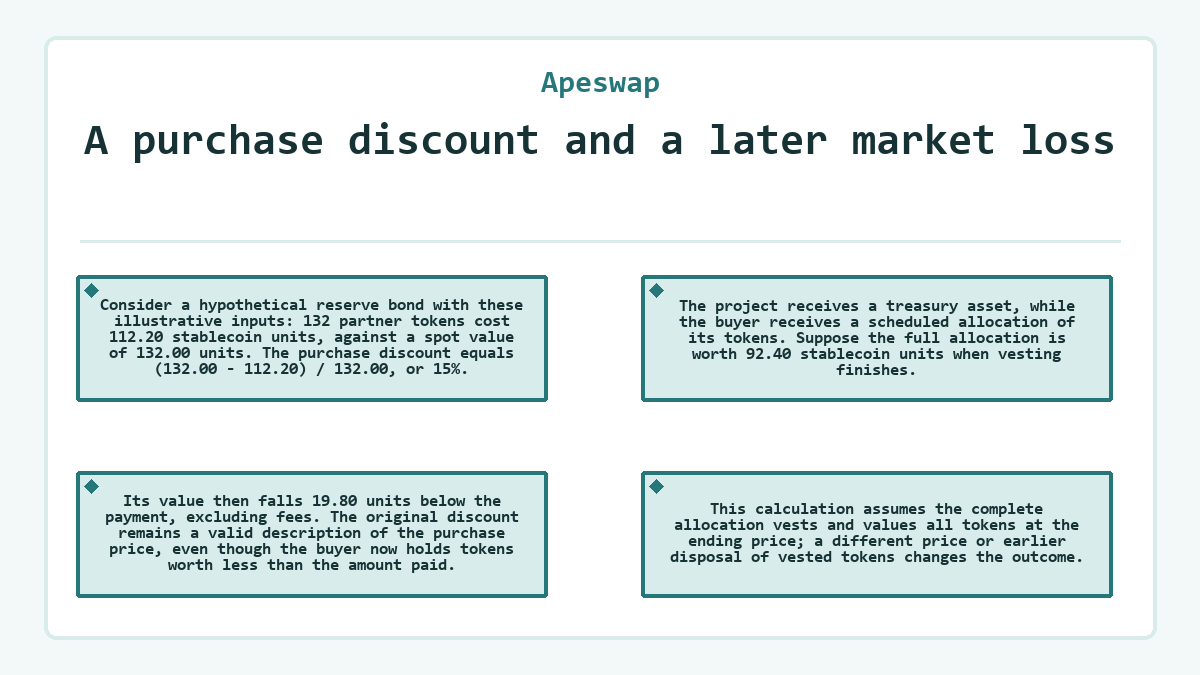
Suppose the full allocation is worth 92.40 stablecoin units when vesting finishes. Its value then falls 19.80 units below the payment, excluding fees. The original discount remains a valid description of the purchase price, even though the buyer now holds tokens worth less than the amount paid. This calculation assumes the complete allocation vests and values all tokens at the ending price; a different price or earlier disposal of vested tokens changes the outcome.
Swap aggregation across supported networks
ApeBond's swap aggregator supports exchanges within one network and routes that combine bridging with token exchange across networks. A same-chain swap stays on its selected blockchain. A cross-chain route moves value between networks as part of the requested exchange. These are distinct uses of the swap service, with different dependencies and costs.
BNB Chain, Polygon, Ethereum and Arbitrum appear in the exchange's network coverage. The legacy interface also distinguishes additional swap-only networks from its primary chains. That distinction concerns product coverage: support for swapping on a network does not establish the availability of every bond, pool or lending market there.
Routing costs and slippage tolerance
Swap costs include routing charges and the fees of the selected DEX route, with bridge costs applying when the route uses a bridge. Slippage tolerance sets the adverse price movement that a trade accepts during execution. Raising that tolerance permits a worse execution price; it does not improve the exchange rate. Price movement beyond the permitted tolerance can cause execution to fail. The Minimum Received estimate reflects the selected tolerance. Network gas adds a separate transaction cost.
ABOND locking and ecosystem rewards
Locking ABOND creates a veABOND position in True Yield, with points that reflect the amount and lock-duration multiplier. Points in fixed-duration positions decline over time without re-locking. Rewards arrive in USDT through weekly epochs, and protocol performance determines the amount available to distribute. Eligible positions receive shares based on their points.
True Yield distinguishes fixed-duration locks from Permalock, which has no expiry. Creating a Permalock burns 80% of the committed ABOND and allocates 20% to the Ecosystem Fund. This option creates a permanent commitment, even though the veABOND position itself can transfer between holders. Transferability does not restore the original ABOND after the mechanism burns it.
ApeBoost directs part of eligible bond sales into ABOND that enters True Yield's permanent-lock mechanism. Qualifying activity can add Ape Points, increase True Yield earning weight and support progress toward higher Ape Tiers.
The 2023 transition from BANANA and GNANA
Apeswap introduced the ApeBond rebrand in A New Era Begins, published on October 10, 2023. The change followed the launch of bonds in early 2022 and a growing emphasis on that product. Its exchange origins explain the trading and liquidity features that remained associated with the older name.
The migration proposal covered BANANA and GNANA conversion into ABOND through special Migration Bonds. Governance approval was a prerequisite for the proposed October 12, 2023 opening.
The announced plan set a 61-day entry window and a shared vesting start of December 12, 2023 at 13:00 UTC. Entering earlier did not advance that start date.
The 2023 plan also treated Polygon BANANA differently because Multichain bridge problems blocked transfers to BNB Chain. It described a support-ticket process for Polygon holders, separate from the ordinary migration entry path.
The original migration window has elapsed. Its dates describe that historical conversion, rather than the vesting schedule of a newly purchased bond. A surviving migration menu entry does not establish that the original window has reopened.
Pools, farms and other legacy products
Legacy pools accepted BANANA or GNANA, while farms accepted LP tokens to earn additional tokens. The exchange also listed Pro Trading with charting and expanded trading options, alongside separate NFT offerings. The legacy listings do not establish that every original reward program continues unchanged. Maximizers, the BANANA vault product, carried an explicit deprecated label.
Lending formed another part of the earlier ecosystem. By the October 2023 migration announcement, borrowing in the BANANA lending market had already stopped. The team asked suppliers to withdraw that asset. This was a restriction on BANANA in the lending network; it was not a statement that every lending market had closed.
Reserve assets and LP tokens as bond payments
Reserve bonds collect a single asset, while liquidity bonds collect LP tokens; the payment type determines what the project acquires. Their purchased tokens can vest over time, but the assets entering the project's holdings differ.
Reserve bonds for treasury funding
Reserve bonds accept the specific single token required by their market, such as a supported stablecoin. The structure lets a project raise treasury assets while distributing an allocation of its own tokens. A buyer's payment therefore supports a treasury objective without transferring an existing liquidity position.
Liquidity bonds and LP-token ownership
Liquidity bonds transfer LP tokens to the project in exchange for a vesting allocation of ABOND or partner tokens. The project controls the acquired liquidity position. The buyer's continuing claim concerns the purchased allocation, rather than ownership of the LP tokens that funded it.
Direct LP-token payment
Direct purchases use the LP tokens required by the particular bond. That requirement concerns the relevant trading pair, so an unrelated LP position does not supply the specified payment asset.
Single-token entry through Zap
Zap provides a single-token entry option for buying a liquidity bond. The entry method changes how the payment starts; the liquidity bond still acquires LP tokens, which distinguishes it from a reserve bond.
The NFT that carries a vesting allocation
ApeBond uses ERC-5725 for its vesting NFTs, which represent token allocations that unlock under their schedules. The NFT holder has the right to claim vested tokens. Owning that NFT differs from already holding the entire underlying allocation as spendable tokens. The remaining schedule and the amount already claimed affect what the position still represents.
Partner support and DAO participation
ApeBond's partner services include advisory and co-marketing work alongside fundraising and liquidity support. Those activities concern how projects structure and distribute their tokens. A partnership can therefore involve operational support beyond the sale of a particular bond. The treasury asset raised, vesting commitment offered and market selected remain separate commercial choices.
Governance remained part of the DAO's stated structure during the rebrand, and the migration plan required a vote. In the veABOND model, holders vote on-chain with voting power based on locked ABOND and accumulated Ape Points. Within the later ecosystem, Ape Tiers connect qualifying positions to benefits that include extra discounts and access to special bonds. Access follows the relevant tier and market conditions; a balance of legacy tokens alone does not establish those benefits.
Apeswap: reader questions
Can I transfer a bond before its vesting period ends?
ApeBond's ERC-5725 bond NFTs support transfer while their underlying tokens remain subject to vesting. Claim rights follow the NFT holder, so transferring the position also transfers control of its remaining allocation. Transferability does not establish that a buyer exists or that a sale will recover the original purchase cost.
Must I collect vested tokens as soon as they become available?
A bond holder can claim tokens as they vest or wait until the vesting period finishes. Tokens that have not vested remain subject to the bond's schedule.
Why can a displayed bond discount become negative?
A negative bond discount means the purchase price exceeds the output token's current market value. Bond pricing responds to input and output token prices, demand and time since the previous purchase. A bond can remain purchasable at a premium, so availability alone does not establish a discounted entry price.
Does the displayed bond discount exclude the purchase fee?
The displayed bond discount already incorporates any applicable user bond fee. The bond-pricing model accounts for that charge in its quoted discount, so adding the same fee again would misstate the quoted deal. This treatment concerns the bond purchase and does not make a separate swap or bridge free.
Will adding ABOND restart a True Yield lock?
Adding ABOND to an existing True Yield position does not reset its lock duration. The additional amount increases the committed balance under the position's applicable terms. Autolock is a separate option that maintains lock duration automatically, so increasing a balance and maintaining its duration describe different changes.
What happened to BANANA outside the 2023 migration?
Under the 2023 plan, unmigrated BANANA would remain BANANA. The 2023 plan tied the ABOND allocation to participation within its designated window; keeping the old token did not automatically convert it into ABOND. Those historical terms does not establish a current route for converting a remaining balance.
Which vesting duration applies to a bond purchase?
The selected bond's schedule determines when its tokens become claimable. ApeBond describes 14 to 60 days as a common vesting range, rather than a universal term. A particular market's schedule governs its allocation, and the dated Migration Bonds program had separate conditions.